Rated at the Equator, Installed in Your Attic: How PSU Derating Shrinks Your 1000 Watts
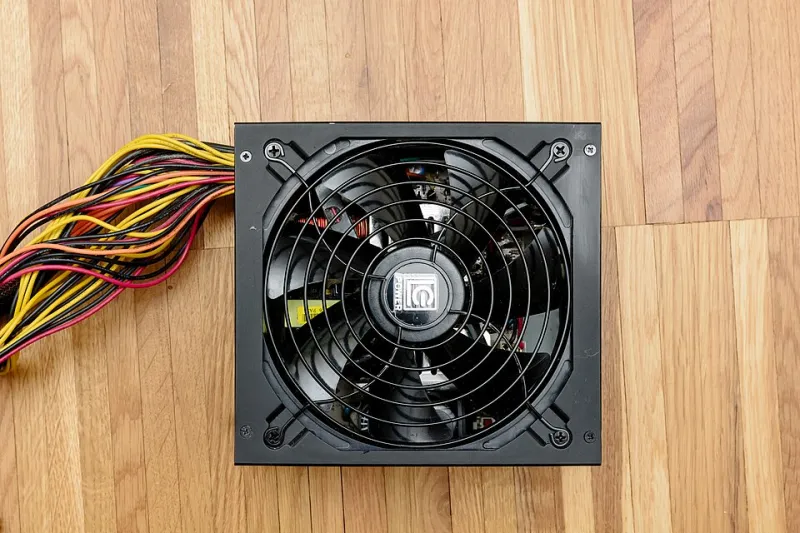
Photo: Henry Kellner, CC BY-SA 4.0, via Wikimedia Commons
Every enthusiast building a high-end PC in the United States has run the same arithmetic: a 450-watt GPU, a 250-watt processor, some overhead for drives and fans, and the conclusion that a 1000-watt power supply leaves a comfortable margin. The arithmetic is correct. The premise, unfortunately, is negotiable.
That 1000-watt figure is not a physical constant. It is a measurement taken under conditions chosen by the manufacturer, and those conditions are frequently more generous than anything inside your case. Understanding how a PSU earns its number — and how quickly that number can shrink — is one of the more useful pieces of literacy a builder can acquire.
Temperature Is Part of the Spec
Switching power supplies lose capacity as ambient temperature rises. The electrolytic capacitors on the secondary side, the switching components, and the magnetics all become less efficient and less tolerant of stress as heat accumulates. Most quality units are rated for full output at 40°C or 50°C ambient; a smaller number of industrial-oriented units claim 50°C continuous, and some consumer units quietly rate at only 30°C.
The problem is that a 50°C rating is rare in a consumer chassis. A well-ventilated mid-tower under a sustained gaming load will typically hold ambient internal temperatures in the mid-30s Celsius, with PSU intake air potentially warmer still if the unit sits above a heat-soaked GPU. In a compact case, a poorly ventilated enclosure, or a summer afternoon in a home without air conditioning — a real consideration in large swaths of the US — intake air to the PSU can approach or exceed the rating temperature.
What happens then depends on the design. A conservatively engineered unit simply runs hotter and keeps delivering its rated output. A tightly cost-optimized unit may throttle its fan aggressively, allow ripple to climb, or, in the worst cases, trip protection circuits during transient spikes. The label does not tell you which behavior you purchased. The temperature at which the rating was validated does, if you can find it — which is precisely why many spec sheets bury or omit it.
Continuous Versus Peak: The Oldest Trick in the Datasheet
The second lever is duration. A supply rated for 1000 watts continuous must sustain that figure indefinitely at its rated temperature. A supply rated for 1000 watts peak need only sustain it briefly — often for seconds or, in some legacy specifications, mere milliseconds — before settling back to a lower continuous ceiling.
Peak ratings were common in the era of Pentium 4 and early ATI/AMD flagships, when GPUs drew enormous transient spikes and vendors discovered that a slightly larger capacitor bank could absorb the difference. The practice has become less egregious, but it persists in marketing language: "1000W max" or "1000W peak" on the box, with the continuous figure smaller or absent entirely. A buyer comparing two boxes side by side at a Micro Center or on a retailer's website may be comparing a continuous rating against a peak rating without either number identifying itself.
The modern wrinkle is that transients have returned. Current-generation high-end GPUs can swing from near-idle to several hundred watts above their average draw in under a millisecond. A PSU whose continuous rating is genuine but whose response to fast transients is sluggish will trip its overcurrent protection into a reboot that looks, to the user, like a system instability — and is usually blamed on the graphics driver.
How to Read the Number Like an Engineer
A practical method for matching a PSU to a modern build does not require an oscilloscope. It requires three questions.
First: at what temperature is the rating valid? If the datasheet states full output at 50°C, the unit has genuine thermal headroom in most consumer builds. If the temperature is unstated, or stated at 30°C, assume the effective capacity inside a warm case is meaningfully lower than the number on the label.
Second: is the rating continuous? The words matter. "Continuous," "100% duty cycle," or a Cybenetics-style rating validated under sustained load are reassuring. "Max," "peak," or a figure that appears only on the retail box should be treated as aspirational until the continuous number is confirmed.
Third: what does the rail-level breakdown look like? A 1000-watt unit delivering 996 watts on the 12V rail and a sliver elsewhere is a different product from one splitting capacity across rails with legacy limits. Modern GPUs live and die on the 12V rail; check that its individual limit covers your GPU's peak transients with margin, not just the aggregate figure.
Applying these questions to a build drawing 700 watts under peak gaming load suggests a supply rated 1000 watts continuous at 40–50°C — not a unit whose 1000-watt figure is a peak number validated in a 25-degree test lab.
The Margin You Cannot See
None of this argues for paranoia, and it certainly does not argue for 1600-watt units in every build, which bring their own inefficiencies at low load. It argues for skepticism about the single most quoted number in the category.
A wattage rating is a contract, and like any contract, the terms are where the meaning lives. The temperature clause, the duration clause, and the rail allocation determine how much of the advertised capacity actually arrives at your components on a hot July afternoon in Dallas. Manufacturers are not lying when they print 1000 watts. They are simply answering a question you did not think to ask.
The enthusiasts who never think about their power supply are the ones who bought enough of it. The spec sheet, read carefully, is how you join them.