One Buzzer to Debug Them All: The PC Speaker's Unlikely Fifty-Year Tenure
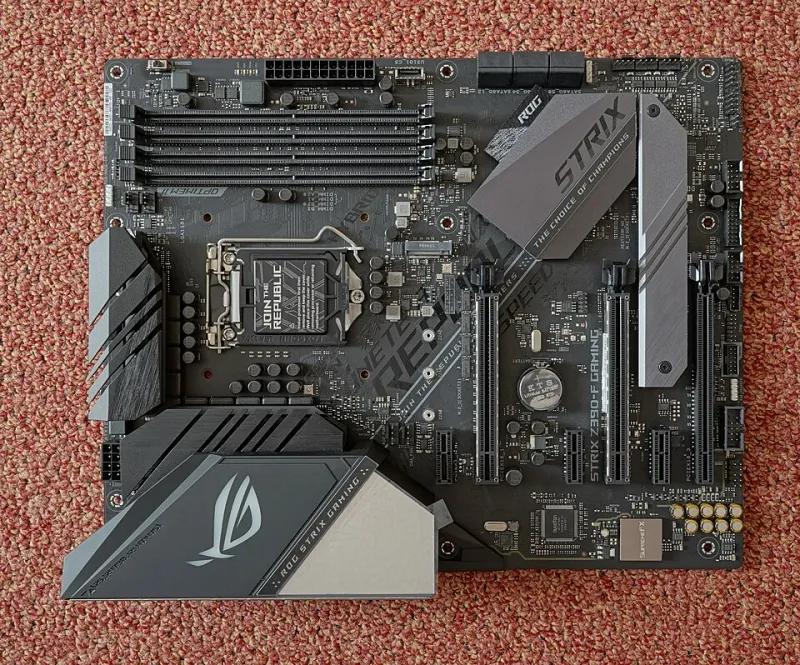
Photo: PantheraLeo1359531, CC BY 4.0, via Wikimedia Commons
Somewhere on nearly every motherboard schematic released in the last four decades sits a small, unassuming component: a header labeled SPK, or a piezo buzzer soldered directly beside the 24-pin ATX connector. Most builders never attach anything to it. Many never hear it. And yet, when a board refuses to POST, that single-channel beeper is frequently the only diagnostic instrument left standing.
The persistence of the PC speaker is not nostalgia. It is the residue of a design decision made at IBM in 1981 that firmware engineers have never found a adequate replacement for.
A Speaker Born From a Cassette Port
The original IBM PC (Model 5150) shipped with a cassette interface for program storage, and the speaker circuit shared its origins in that economy-minded design. The machine's designers, led in part by David Bradley's team, wired a small speaker through gate control on the 8255 programmable peripheral interface, clocked by timer channel 2 of the 8253 PIT. This gave software two ways to make noise: program timer channel 2 with a frequency divisor, or bit-bang the gate directly.
Crucially, the speaker was not wired to the audio subsystem — because there was no audio subsystem. It was a general-purpose square-wave generator hanging off the system timers, cheap to implement and trivially testable. When the cassette interface faded away within a couple of years, the speaker stayed, repurposed almost immediately by the BIOS as an error reporter.
Why Beep Codes Existed at All
The logic is brutal in its simplicity. POST diagnostics assume the worst: the video card may not initialize, the keyboard controller may be dead, the memory subsystem may be unreliable. You cannot print an error message to a display that might not work, or write a code to a serial port that might not exist. But if the CPU executes at all, and the timer circuit functions, you can count beeps.
The classic AMI and Award codes became folklore among technicians: one long followed by two short suggesting a graphics failure on Award boards, three short pointing at conventional memory on AMI, continuous beeping indicating a memory or power fault. The codes were never standardized across vendors — a fact that generated decades of errata sheets taped inside repair shop cabinets — but the mechanism was universal because the firmware vendors (AMI, Award, later Phoenix) licensed the same core ROM to everyone.
The UEFI Era: Same Beep, New Bureaucracy
A common assumption is that UEFI killed the beep code. It did not. The UEFI Specification Consortium standardized the Status Code mechanism (formerly POST codes) under the PI specification, and beep codes remain a defined fallback output for systems without a debug port. What changed is the hierarchy: a modern board with a two-character hexadecimal LED display or a set of Debug LEDs (the familiar CPU/DRAM/VGA/BOOT quartet on consumer boards) will report there first. The speaker becomes the tertiary channel — but it is the channel that works when the display subsystem itself is the failure.
This is the quiet justification for the circuit's survival. A dead GPU produces no image, no LED indication on many boards, and no USB keyboard response. It does, however, produce a beep pattern. Technicians troubleshooting a no-POST build in a workshop still reach for a speaker header jumper before they reach for a spare graphics card, because the beep discriminates between "CPU never started" and "CPU started but video init failed" in under five seconds.
The Debug Chain, Ranked by Reliability
It helps to think of modern diagnostics as a fallback ladder:
- Q-LED / Debug LEDs — visible, but require the board to reach a point where the embedded controller drives them.
- Two-digit POST code displays — richer data, but absent on budget boards and unreadable inside a closed case.
- Beep codes — audible through a case side panel, functional on nearly any board with a header, and independent of the display pipeline.
- Serial/USB debug — powerful, but a developer tool, not a service counter tool.
The speaker occupies the rung that costs pennies and requires no user configuration. That economics explain its longevity better than any argument about tradition.
Retirement or Reverence?
There is a credible case for retirement. Intel and AMD have steadily folded platform functions into the PCH and Super I/O dies, and some recent boards — particularly compact ITX designs — omit the speaker header entirely, relying on Debug LEDs alone. Case manufacturers, for their part, stopped including speakers in chassis around the mid-2000s, which means most users building a system today have no beeper to connect even if the header exists.
But the counterargument is stronger than it looks. A piezo element costs fractions of a cent. The firmware code paths driving it are trivial and already exist in every BIOS vendor's codebase. And the failure mode it diagnoses — a system too broken to display anything — is precisely the scenario where every alternative diagnostic is blind. Removing it saves nothing measurable and eliminates the one feedback channel that works when nothing else does.
The verdict, then, is reverence, if a quiet one. The PC speaker is the last component on a modern board whose design lineage runs unbroken to the 5150, and the only one whose entire purpose is to speak when the system cannot. Fifty years on, it remains the cheapest insurance policy in the PC. The industry has kept stranger traditions for worse reasons.