Fifteen Dollars Versus Your 280mm AIO: The Case of the Concave IHS

There is a particular kind of frustration familiar to anyone who has built a high-end Alder Lake, Raptor Lake, or Arrow Lake system: you mount a premium 360mm AIO, apply quality paste, and still watch your i9 drift past 95°C in a Cinebench run. The cooler is not the problem. The paste is not the problem. The problem, in many cases, is that the CPU is not flat.
The Bow in the Metal
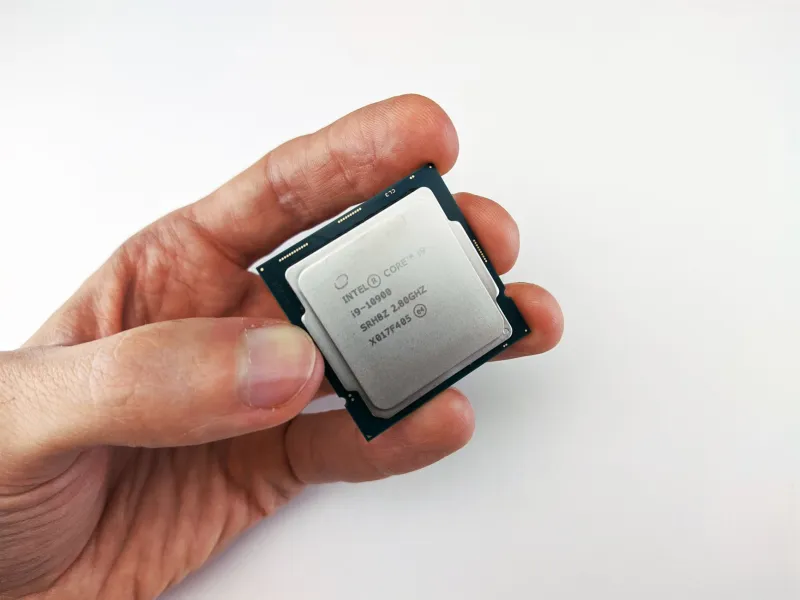
When Intel moved from the long-lived LGA1200 to LGA1700 with Alder Lake, the retention mechanism changed in a way that mattered. The ILM — the independent loading mechanism that clamps the processor into the socket — pushes down on the substrate at two points, while the IHS above it is anchored by solder. The resulting torque bows the integrated heat spreader into a slight concave shape, with the center dipping away from the cooler's cold plate by a measurable margin.
Igor's Lab documented this deflection early in the LGA1700 lifecycle, measuring gaps at the IHS center that approached a tenth of a millimeter on some samples. That sounds trivial. It is not. Thermal paste is designed to fill microscopic irregularities measured in microns; it is not designed to bridge a physical air gap. Air is a terrible conductor of heat — roughly 0.026 W/mK versus about 7.5 W/mK for a decent paste — so any region where the cold plate is separated from the IHS by air becomes a thermal bottleneck.
The practical consequence is uneven heat distribution across the die. Contact-frame advocates have long argued that a portion of the notorious Raptor Lake thermal behavior was never the silicon's fault at all.
What a Contact Frame Actually Does
A contact frame — most famously the Thermal Grizzly Lazy Frame and earlier units from ILM modification kits — replaces Intel's stock ILM entirely. Instead of two narrow loading arms pressing on the substrate edges, the frame distributes clamping force across the IHS itself, pulling it flat against the cooler rather than pushing the substrate up into it.
The results reported across independent testing have been consistent in direction, if variable in magnitude:
- Idle and light loads: Deltas of 2–5°C, sometimes more, because the bow is most consequential when heat output is low and the paste has not fully equalized.
- Sustained all-core loads: Typically 3–8°C on Raptor Lake parts, with some reviewers recording double-digit improvements on specific 13900K samples.
- Delta variance: Two identical CPUs can respond differently. A sample with minimal bow shows smaller gains; a badly warped one can transform.
On LGA1851, the situation is less severe but not eliminated. Arrow Lake's IHS is thicker and the mounting geometry revised, and most testing shows smaller — but still real — deltas in the 2–5°C range.
The Warranty Question, Answered Honestly
Removing the stock ILM requires unscrewing Intel's retention mechanism, which is a warranty gray area that has been litigated in forum threads for three years now. The practical reality: Intel has not made a practice of denying RMAs over contact frame use, and Thermal Grizzly explicitly designs its frames for this purpose. Still, an enthusiast should weigh a several-hundred-dollar CPU against a handful of degrees. If your chip holds 85°C under load with adequate performance, the frame buys you nothing you need.
Who Should Buy One
Buy it if: you are running a 13700K, 13900K, 14900K, or 14900KS and chasing lower sustained temperatures for noise or boost-clock reasons; you are a heavy multi-core user; or you are delidding-adjacent curious but not ready for liquid metal.
Skip it if: your thermals are already acceptable, you are on Arrow Lake with modest loads, or the idea of removing a socket mechanism on a $600 processor makes your palms sweat. A high-end paste applied correctly, plus a case with real airflow, may close most of the gap for less money and zero risk.
The contact frame is not a magic product. It is a correction — a $15 fix for a mounting geometry that treats flatness as optional. For the enthusiast who has already optimized everything else, it is one of the few remaining free lunches in the thermal stack, even if the lunch costs fifteen dollars.