Between the Die and the Lid: A Material History of the CPU's Hottest Interface
Every modern desktop processor hides its most important thermal component under a nickel-plated copper lid. The integrated heat spreader (IHS) does not merely protect the die during cooler installation — it is the final link in a thermal chain that runs from transistor junction to heatsink fin. And the material filling that link, the thermal interface material (TIM), varies dramatically between vendors, product tiers, and even individual product generations.
Understanding what sits beneath the lid explains a great deal: why some chips shed ten degrees when delidded, why others resist any attempt to open them, and why the phrase "warranty void" carries different weight depending on which company made your CPU.
Three Materials, Three Philosophies
The industry has settled on three primary approaches to bonding die to spreader.
Indium solder is the enthusiast gold standard. Indium is a soft metal with excellent thermal conductivity — roughly 80 W/mK, an order of magnitude better than most pastes — and it remains pliable enough to absorb the coefficient of thermal expansion mismatch between silicon and copper. Intel adopted solder broadly with Skylake-X in 2017 after years of enthusiast complaints about its polymer TIM on high-core-count chips. AMD has used a solder-based solution (branded "Indium Tin" or "Gallium-based" depending on generation) across its Ryzen lineup since 2017.
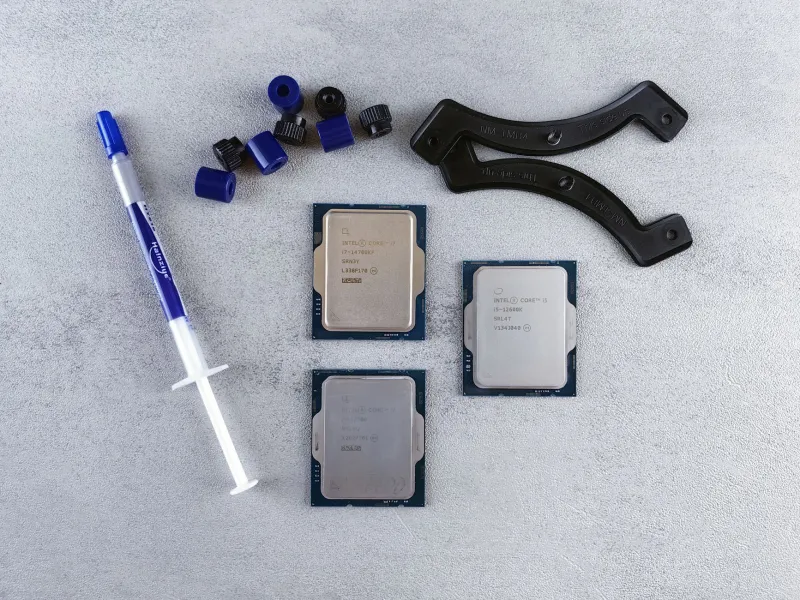
Polymer TIM is Intel's cost-driven alternative on most mainstream parts. It is a silicone-based paste that outgasses and pumps out over time, which is why a 12700K running at stock will typically run several degrees hotter than the same die soldered. The gap between soldered and polymer-cooled parts of the same architecture is the entire business case for the delidding hobby.
Adhesive strategy is the third, less discussed variable. How the IHS is attached to the substrate determines whether it can be removed at all. Intel historically used a perimeter of glue that could be carefully cut with a razor blade or a delidding tool. AMD's Ryzen chips used a substrate-mounted design where the IHS is clipped and lightly adhered — but certain generations added an epoxy blob at the die's edge specifically to deter removal, a deliberate anti-delidding measure that has claimed many a die.
The Delidding Calculus
For the DIY overclocker, the decision tree is straightforward in theory. Soldered chips gain little from delidding — indium already outperforms nearly anything an enthusiast can apply afterward, and liquid metal risks corroding the nickel plating over time. Polymer-TIM chips can shed 5 to 15 degrees Celsius under load, translating directly into higher sustained all-core frequencies or quieter cooler operation.
In practice, the calculus has shifted. Direct-die cooling — mounting a cooler directly on the die with the IHS removed — has become viable on hybrid architectures like Intel's Alder Lake and Raptor Lake, where the small E-core cluster sits at a different height than the P-cores. Enthusiast coolers such as the Direct Die frames sold by Thermalright and others are designed explicitly for delidded Intel chips, and the practice has moved from the realm of LN2 benchers to something a careful hobbyist can attempt with a $30 kit.
The risk profile remains nontrivial. Cutting too deep severs substrate traces. Removing the adhesive without reheating the solder joint can crack the die. And reattaching the IHS — or choosing not to — changes mounting pressure in ways that can kill a board's socket pins.
The Warranty Question
Delidding formally voids the warranty on both Intel and AMD processors, though the enforcement mechanisms differ. Intel's historical practice of shipping CPUs with a "warranty void if removed" sticker on the IHS itself was abandoned years ago; today, warranty status is determined by serial number and physical inspection rather than tamper-evident seals. AMD has never used an IHS sticker on Ryzen parts, relying instead on the reality that a delidded chip is usually a visibly damaged chip.
Both companies have shown leniency in edge cases, and neither has pursued legal action against individual delidders in the United States. The Magnuson-Moss Warranty Act offers some theoretical protection against blanket warranty denial, but the practical reality is simpler: delidding is a mod that assumes the risk of the mod.
What to Check Before You Reach for the Razor
For readers considering a first delid, the reference checklist is short:
- Identify the TIM. Consult delidding databases and community teardowns for your exact stepping and production batch. Intel has changed TIM composition mid-generation without notice.
- Check the adhesive. AMD's epoxy-dotted chips are a hard no for beginners. Intel's perimeter glue is more forgiving.
- Budget for replacement. Liquid metal (Galinstan-based compounds) is the standard reapplication for delidded parts, and it requires deliberate application — it is electrically conductive and aggressively attacks aluminum.
- Accept the risk. A failed delid is, in most cases, a dead CPU with no recourse.
The broader takeaway is that the die-to-lid interface is not an afterthought of packaging. It is a deliberate engineering and cost decision that shapes thermals, acoustics, and the ceiling of what aftermarket cooling can achieve. Enthusiasts who read the substrate as carefully as the spec sheet will always know more about their chip's true limits than the box ever revealed.