The Boost Clock Countdown: Measuring How Long Advertised Frequencies Survive
Every processor box sold in the United States carries at least one number that behaves like a promise: the maximum boost clock. A 5.7 GHz figure printed in bold type suggests a machine that operates at 5.7 GHz. The reality is more nuanced, and understanding the mechanics behind frequency decay is essential for anyone evaluating a modern CPU purchase.
What a Boost Specification Actually Describes
Boost clocks are, by definition, transient. They represent the frequency a core can reach when thermal headroom, power budget, and current limits all align — conditions that exist for seconds, not minutes. Intel's Thermal Velocity Boost and AMD's Precision Boost Overdrive both describe opportunistic states: the processor takes whatever the cooling solution and power delivery will permit, and no more.
This is not false advertising. It is a documentation convention that rewards readers who understand the fine print. A single-threaded burst — launching an application, opening a browser tab — genuinely hits the advertised figure on a well-cooled system. The question is what happens when all cores are asked to work simultaneously.
The All-Core Collapse
Under an all-core workload such as code compilation or video encoding, sustained frequencies typically settle 15 to 25 percent below the maximum boost figure. A chip advertising 5.7 GHz may hold 4.6 to 4.9 GHz across all cores once it reaches thermal steady state. This equilibrium point — where heat dissipation equals heat generation — is the processor's true operating condition for sustained work.
Three limits govern where that equilibrium lands:
- Thermal limit (Tjmax): Once the junction temperature ceiling is reached, the processor reduces frequency to hold the line. This is the dominant constraint on smaller air coolers.
- Power limit (PL1/PL2 or PPT): Even with excellent cooling, a chip consuming more than its sustained power budget permits will shed frequency to stay within specification.
- Current limit (EDC/IccMax): Voltage regulator constraints can clamp frequency independently of both temperature and power.
Whichever limit binds first determines the sustained clock. Enthusiasts running 240mm liquid coolers on high-end parts are frequently power-limited rather than thermally limited, which means better cooling stops helping beyond a certain point.
Cooling Tiers and Their Diminishing Returns
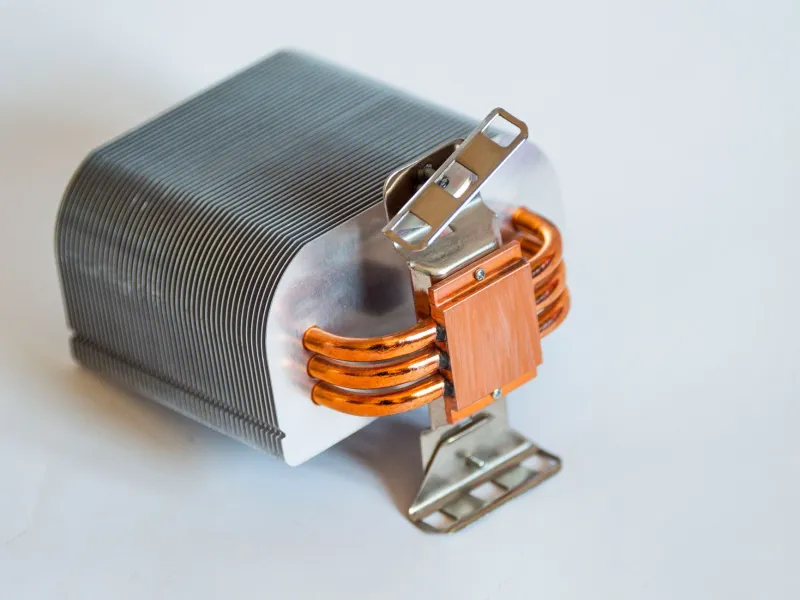
The gap between cooling scenarios narrows considerably at the top end. A stock cooler, a 120mm tower, and a 280mm liquid loop produce meaningfully different sustained clocks on a 250-watt-class processor — often 200 to 400 MHz separating each tier. But the delta between a 280mm AIO and a custom loop rarely exceeds 100 MHz, because the chip has already hit its power ceiling.
This is the practical takeaway: cooling investment pays dividends up to the power limit, then stops. A $40 tower cooler is arguably the best value in the entire cooling market for this reason. Anything beyond it buys acoustics and temperature margin, not performance.
A Framework for Reading Boost Claims
Rather than treating the advertised boost clock as an operating frequency, enthusiasts should treat it as a ceiling with a predictable discount:
- Single-core burst performance approaches the advertised figure under nearly any competent cooler.
- All-core sustained performance can be estimated at roughly 75 to 85 percent of maximum boost for high-power desktop parts, and somewhat closer for efficient mobile chips that ship with conservative power limits.
- Workload duration matters. A five-minute render and a five-hour compile will land at the same sustained clock only if the cooling solution can reach steady state — larger thermal masses delay, but do not prevent, the inevitable equilibrium.
Review data from independent US testing outlets consistently confirms this pattern across both current-generation Intel and AMD desktop platforms, which suggests the behavior is architectural rather than a vendor-specific quirk.
The Specification That Isn't on the Box
Ironically, the most predictive number for sustained performance — the rated sustained power limit — is often the hardest to find. It lives in BIOS documentation and platform datasheets rather than retail packaging. Enthusiasts willing to read those documents gain a far more accurate picture of real-world behavior than any boost clock can provide.
The boost figure still has value. It indicates the silicon's potential and the platform's headroom. But like a car's top speed on a closed track, it describes a condition most owners will rarely visit. The sustained all-core clock, unglamorous and unpublished, is the number that governs the work you actually do.